How much of what you call judgment is actually just the last time you saw something similar?
That question is worth sitting with longer than feels comfortable. Experienced leaders build pattern libraries over careers. Those libraries are genuinely useful, compressing the time it takes to read a situation, make a call, and move. The problem is that the same mechanism that makes experienced leaders fast also makes them wrong in ways they rarely recognize. Pattern recognition doesn’t announce itself as pattern recognition. It announces itself as judgment. And judgment, by definition, doesn’t get questioned the way data does.
This is where most signal interpretation problems actually live. Not in a failure to observe, but in a failure to examine what the observation means.
Most leadership teams operating in SaaS and tech environments are reasonably good at gathering information. They have dashboards, pipeline reviews, NPS programs, delivery metrics, customer success data. The signals exist. The question is what happens to them between observation and decision. In most cases, interpretation happens fast, draws on prior experience, and arrives at a conclusion that feels settled before anyone asks whether it’s right.
That gap between observation and honest interpretation is where strategic accuracy gets lost.
Here is what this looks like in practice. A SaaS company starts seeing longer sales cycles. The CRO has navigated this before. Market confidence is low, economic uncertainty is making buyers cautious, and the pattern will pass. The team adjusts the pitch, adds more ROI justification, and waits it out.
What didn’t get examined was whether the elongation was coming from a different source entirely. Not buyer hesitation, but buyer confusion. Prospects were taking longer because they couldn’t figure out how the product fit their current stack. The competitive landscape had shifted. Two new entrants were offering simpler, more integrated solutions. The longer sales cycle wasn’t a market signal. It was a product-market fit signal wearing market conditions as a disguise.
The CRO’s read wasn’t lazy. It was experienced. That’s the problem. The pattern was familiar enough that interrogating it felt unnecessary. The conclusion arrived before the question got asked.
This is the interpretation gap. It sits between observation and insight and it’s where experienced leadership teams lose the most ground, not because they stop looking, but because they stop questioning what they’re seeing. Data doesn’t become insight automatically. It becomes insight when the person reading it asks what it might mean, including what it might mean beyond the most obvious explanation. That step gets skipped most often by the people with the most experience, because their pattern library fires quickly and the result feels like clarity.
Several specific mechanisms drive this in SaaS and tech organizations.
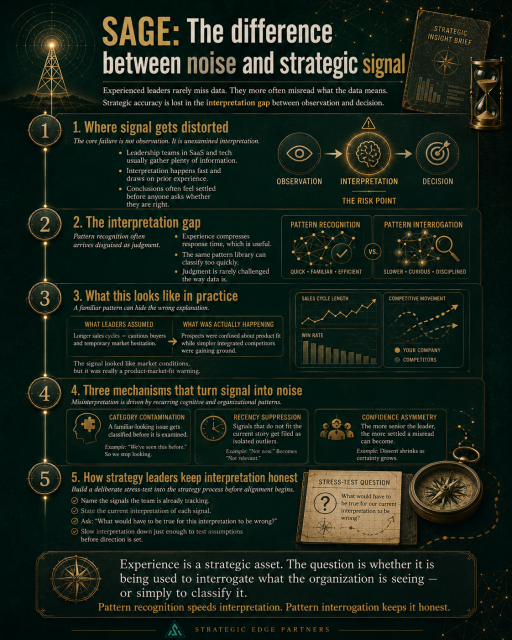
The first is category contamination. A signal that resembles a known problem gets classified as that problem without examination. Churn ticks up. The leadership team has seen this before: onboarding issues, customer success capacity, pricing sensitivity. Each of those has a playbook. The playbook gets activated. Meanwhile the actual driver, a competitor that launched a migration tool three months ago and has been quietly picking off dissatisfied accounts, doesn’t surface until someone examines closely the pattern of who specifically is churning, when they started evaluating alternatives, and what those alternatives have in common.
The second is recency suppression. Signals that don’t fit the current narrative get mentally filed as outliers. A handful of enterprise deals stalling at legal review. A product feedback theme appearing consistently in support tickets but not matching roadmap priorities. A delivery metric that’s been slightly off for two quarters but not enough to trigger escalation. Individually, each looks manageable. Together they’re describing something the organization hasn’t named yet, and the reason they haven’t been connected is that each one got classified separately rather than examined as part of a pattern.
The third is confidence asymmetry. The more senior the leader, the more certain the misread tends to be. This isn’t arrogance. It’s the natural result of having a large pattern library and a long track record that reinforces trusting it. When a CEO who has navigated three market downturns says this feels like 2019, the room accepts that framing. Nobody asks whether 2019 is actually the right reference point, whether the underlying conditions are comparable, or whether the current situation has structural differences that matter. The experience that makes the comparison credible is also what makes it hard to challenge.
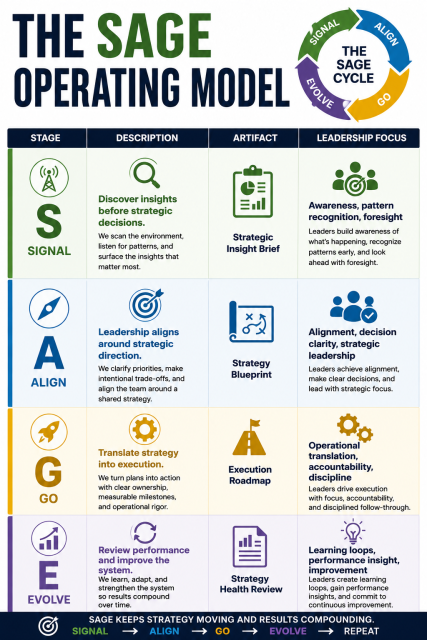
In the Signal stage of the SAGE operating model, the Strategic Insight Brief includes a section on strategic assumptions specifically to create a structured moment where this kind of interrogation happens. The question that section asks is not what does the leadership team currently believe. It’s what does the team believe, and what would have to be true for those beliefs to be wrong.
That’s a different exercise than reviewing market data or summarizing competitive activity. It requires taking the interpretations that feel most settled and holding them up for examination. Longer sales cycles: what else could that be beyond market conditions? Churn increasing in a specific segment: what else could that be beyond product gaps? A competitor making a move that looks minor: what else could that be beyond a niche play that doesn’t affect our core market?
The goal isn’t to manufacture doubt. It’s to slow the interpretation step down enough that the pattern library gets interrogated rather than just activated. One extra question, asked consistently before direction gets set, catches a meaningful percentage of the misreads before they harden into strategy.
For executives and strategy leaders, the practical implication is about process design rather than individual behavior change. Asking experienced leaders to be less confident in their pattern recognition isn’t a workable instruction. It runs counter to the skills that made them effective. What is workable is building a moment into the strategy process where current interpretations get explicitly stress-tested before the team moves to alignment.
That means naming the signals the team is already tracking, stating the current interpretation of each, and then running the second question together. Not as a challenge to any individual’s read, but as a standard part of how the leadership team prepares to make decisions. The organizations that do this consistently tend to catch the interpretations that are slightly off before they harden into strategic direction. The ones that don’t tend to find out considerably later that the pattern wasn’t what it looked like.
Experience is a genuine strategic asset. Leaders who have navigated multiple market cycles, product pivots, and competitive shifts bring something to a strategy conversation that data alone can’t provide.
The question worth asking is whether that asset is being used to interrogate what the organization is seeing or simply to classify it. Pattern recognition and pattern interrogation are related disciplines. One speeds up interpretation. The other keeps it honest. Both are necessary, and only one of them tends to show up in the strategy process by default.