When was the last time your leadership team left a strategy meeting genuinely aligned, versus just done with the conversation?
Those are different outcomes. The first means the team has a shared understanding of the direction, why it was chosen over the alternatives, what it requires them to stop doing, and what success looks like in concrete terms. The second means the meeting ended, the deck got filed, and everyone went back to their desks with their own version of what was decided.
Most SaaS leadership teams are operating somewhere in the second category more often than they’d admit. Not because the leaders are ineffective, but because the process that produces agreement in a meeting and the process that produces genuine alignment are not the same thing. One is about reaching the end of the agenda. The other is about building a shared operating picture that actually changes how decisions get made afterward.
The difference shows up fast. Within weeks of a strategy session, the CPO is prioritizing features that the CRO’s team can’t sell yet. The VP of Customer Success is resourcing for a customer profile that the product roadmap is quietly moving away from. The CFO approved a headcount plan based on a growth assumption that the CEO has already begun to revise mentally. Nobody made a bad call in isolation. The strategy just never became a shared operating picture. It stayed a presentation.
This is what strategic misalignment actually looks like inside a SaaS organization. Not a dramatic disagreement. No visible conflict. Gradual divergence in how each function interprets the direction and makes decisions within it. By the time it surfaces as a problem it usually looks like execution failure, missed targets, a product that isn’t quite landing, a sales motion that’s slightly off. The root cause, that the leadership team was never actually aligned, is much harder to name because everyone attended the same meetings and approved the same plan.
Real alignment requires three things that most strategy processes treat as optional or assume will happen naturally.
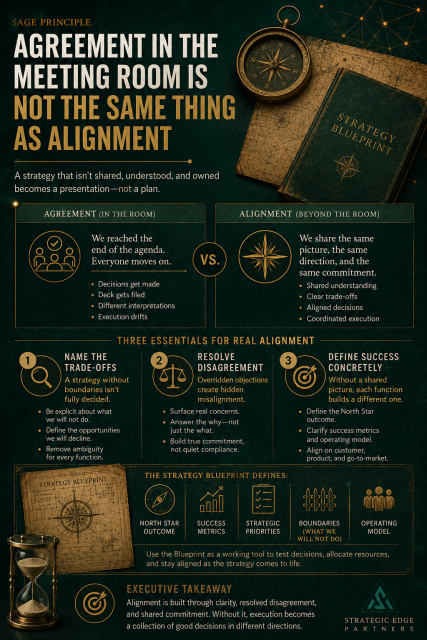
The first is explicit acknowledgment of what the strategy is not. Every strategic direction involves trade-offs. Choosing to move upmarket means not optimizing for the SMB segment you know well. Choosing to deepen the platform means not expanding horizontally into adjacent features that individual customers keep requesting. Choosing to focus on a specific use case means walking away from deals that don’t fit it.
Most leadership teams announce the direction without explicitly naming the trade-offs. This creates a gap. Each function hears the direction and mentally fills in the implications based on its own priorities. The CPO hears platform depth and continues to evaluate adjacent feature requests on their merits. The CRO hears upmarket and keeps the SMB team running at full capacity because the pipeline is there. Neither is ignoring the strategy. Both are operating without a shared understanding of what they are actually required to deprioritize.
A strategy that hasn’t named its trade-offs hasn’t been fully decided. It’s been announced.
The second is a genuine resolution of disagreement before the session ends. Leadership teams in SaaS environments are typically composed of smart, opinionated people who have strong views about what the business needs. In most strategy sessions, those views get aired, the most senior voice or the most persistent argument wins, and the team moves on. The leaders whose views didn’t prevail leave the room having heard the decision but not having genuinely shifted their position.
This matters more than it looks like it should. A leadership team in which two members are privately unconvinced of the direction will make hundreds of small decisions over the following months that subtly reflect their actual views rather than the stated strategy. Resource allocation and hiring criteria deal with prioritizing which product investments to accelerate. None of those decisions will be visibly off-strategy. Collectively, they will pull the organization in a slightly different direction than the leadership team agreed to in the room.
Alignment doesn’t require consensus. It requires that the disagreement be resolved explicitly rather than overridden. The leaders who weren’t convinced need a real answer to their objection, not just a majority vote. When that answer doesn’t come, the misalignment goes underground rather than disappearing.
The third is a shared definition of what success looks like in concrete terms. Not revenue targets, every leadership team has those. A shared picture of what the organization looks like when the strategy is working. Which customer segments are growing? What the product does that it doesn’t do today. How the sales motion has changed. What delivery looks like at the scale the strategy requires. What capabilities has the team built that it doesn’t currently have?
Without that picture, each function builds its own version. Six months into execution the leadership team discovers they’ve been building toward subtly different destinations. The product org was built for one customer profile. Sales hired for another. Customer success designed an onboarding model that fits neither particularly well. Everyone executed. Nobody was working from the same picture.
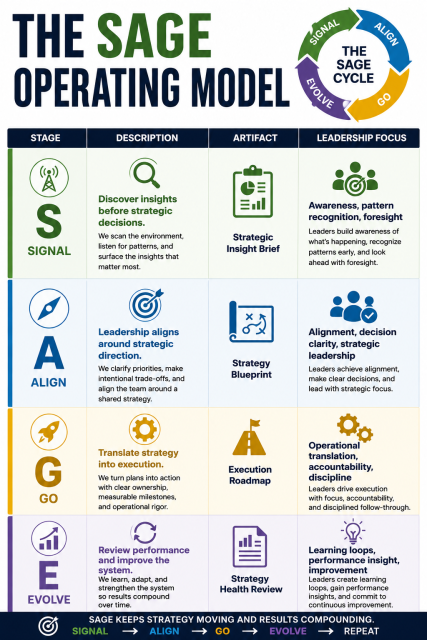
In the SAGE operating model, the Strategy Blueprint is the artifact that makes alignment concrete. It defines the North Star outcome, success metrics, strategic priorities, and the strategy’s boundaries. The boundaries are the part most teams skip. What the organization will not do, which opportunities it will decline, which customer requests it will deprioritize, and which markets it will ignore. Without those boundaries, the strategy has direction, but no edges, and a strategy without edges expands to fill whatever space the organization’s existing habits and preferences create.
The Blueprint exists to give the leadership team a shared document to test their alignment against. Not a presentation to show the board. A working artifact the team uses to examine whether their individual plans and decisions are actually coherent with each other. That examination is uncomfortable work. It surfaces the places where the team isn’t as aligned as the strategy meeting suggested. That’s exactly why it matters.
For SaaS executives, the practical question is whether the output of the strategy process is something the leadership team actually uses to make decisions, or something that gets presented and filed. A strategy document that lives in a slide deck is a presentation. A strategy document that gets pulled out when there’s a resourcing disagreement, a product prioritization debate, or a question about which deals to pursue is an operating tool.
The difference between those two things is the difference between a leadership team that attended the same strategy session and one that is genuinely aligned. One produces coordinated execution. The other produces a collection of individually reasonable decisions that add up to an organization moving in several directions at once.
Strategy doesn’t fail at execution. It fails the moment the leadership team leaves the room, operating from different versions of what was decided.