How many strategic plans from the last three years are sitting in a slide deck that nobody has opened since the quarterly business review?
Most SaaS leadership teams would answer that question honestly if they had to. The strategy work got done. The offsite happened, the priorities got set, and the presentation was polished and delivered. Three months later, the organization is running on the same operational logic it had before the strategy session. The roadmap reflects last year’s assumptions. The sales motion hasn’t changed. The resource allocation looks identical to the prior quarter. The strategy exists as a document. It never became work.
This is the translation problem. It sits between strategic direction and operational reality, and it’s where most strategy efforts quietly die. Not dramatically, not because anyone decided to ignore the plan, but because the bridge between what the leadership team agreed to and what actually happens on Monday morning was never built.
The translation problem gets misdiagnosed almost every time it surfaces. When strategy doesn’t become operational work, the default explanation is a lack of execution discipline. The team didn’t follow through. The organization lacks the rigour to implement. The middle layer isn’t accountable enough. These explanations feel credible because execution eventually fails, but the failure usually starts much earlier, at the moment the leadership team finishes the strategy conversation and assumes the operational implications are obvious.
They aren’t obvious. That’s the structural problem most SaaS leadership teams don’t account for.
A strategic direction tells an organization what it is trying to achieve and why. It does not tell a product manager which items to move up the roadmap and which to defer. It does not tell a sales leader which deals to pursue aggressively and which to walk away from. It does not tell an engineering team how to sequence the next quarter’s work. It does not tell a customer success team which accounts to prioritize for expansion versus which to manage for retention. All of those decisions require someone to take the strategic direction and work out the operational implications, specifically enough that the people making daily decisions have something to work from.
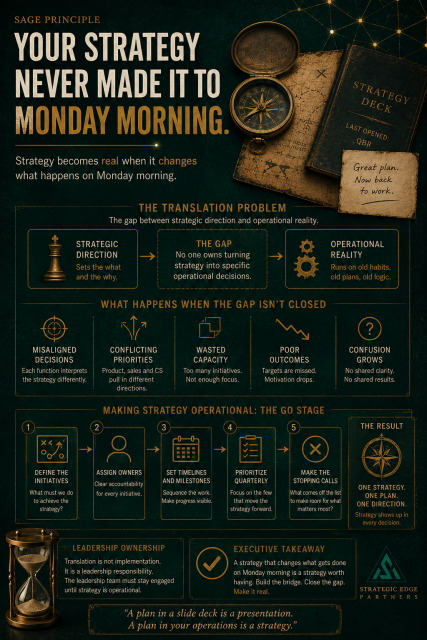
In most SaaS organizations, nobody is explicitly responsible for that translation. The Chief Executive Officer and the leadership team own the strategy. The functional leaders own their operations. The gap between those two things, the specific work of turning strategic direction into operational decisions, falls into the space between them. Each functional leader translates the strategy through the lens of their own function. The result is a set of operational plans that are individually coherent yet collectively inconsistent, each optimized for the function that built it rather than for the strategic outcome the organization is trying to achieve.
The product roadmap gets built around what the product team believes the strategy requires. The sales plan gets built around what the revenue team believes it requires. The hiring plan gets built around what each functional leader believes their team needs to deliver. When those plans hit reality together, the inconsistencies surface immediately. The product isn’t ready for the deals the sales team is closing. The customer success team is resourced for a customer profile that the product roadmap is moving away from. The engineering capacity doesn’t match the strategic priorities that the leadership team set three months ago.
None of this is visible during the strategy process because the operational translation occurs after the strategy session ends, within individual functions, without a structured process to test whether the pieces are coherent with one another.
There is a second layer to the translation problem that’s less obvious and more damaging. Even when functional leaders make a genuine effort to translate the strategy into their operational plans, the translation tends to happen at the level of initiatives rather than decisions. A new strategic priority becomes a new project on the roadmap. A shift in customer focus becomes a new sales motion added alongside the existing one rather than replacing it. A commitment to platform depth becomes an additional investment without a corresponding reduction elsewhere.
The strategy gets added to the existing operational reality rather than changing it. The organization ends up running its previous operational model plus a set of new initiatives that reflect the new strategy, with no additional capacity to execute either particularly well. This is how SaaS organizations end up with roadmaps that are twice as long as the team can deliver, sales teams pursuing too many segments with too little focus, and customer success organizations stretched across a customer base that has grown more complex than the model was designed to handle.
The translation problem at this layer isn’t a failure to understand the strategy. It’s a failure to make the operational changes the strategy actually requires. Real translation means stopping things, not just starting them. It means the new strategic priority comes with an explicit decision about what gets removed from the roadmap to make room for it. The shift in customer focus entails deciding which existing customer segments receive less attention and which sales motions are retired. The commitment to platform depth comes with a reduction in the breadth of features the team is maintaining.
Those are hard decisions. They require the leadership team to stay engaged in the operational translation process rather than handing it off after the strategy session ends. In most SaaS organizations, the leadership team considers its strategy work complete when the direction is set. The operational translation is treated as implementation, something the functional leaders handle. That division is where the gap lives.
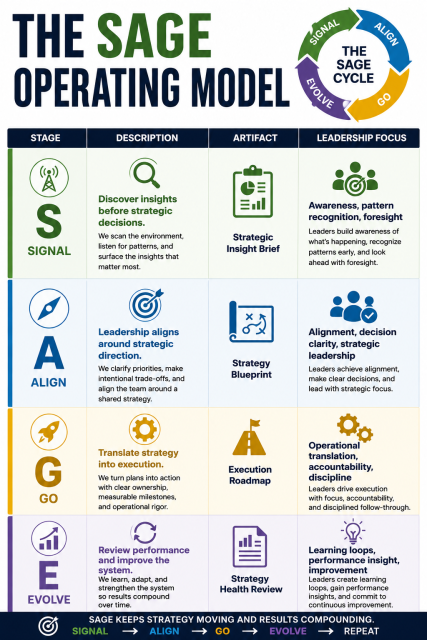
In the SAGE operating model, the Go stage is where strategy becomes operational. The Execution Roadmap is the artifact produced at this stage, and it is deliberately different from a project plan or a product roadmap. It defines the initiatives that translate the strategy into action, the owners responsible for each, the timelines, the milestones, and the quarterly priorities that sequence the work to reflect the strategic direction rather than just existing operational capacity.
The Execution Roadmap also requires the leadership team to make the stopping decisions explicit. What comes off the list to make room for the new priorities? Which existing initiatives are no longer consistent with the strategic direction? Which operational commitments need to change to reflect the new focus? These decisions are as much a part of the operational translation as the new initiatives, and they are the ones most leadership teams avoid because they require revisiting commitments made before the strategy changed.
For SaaS executives, the diagnostic question is whether the strategy session produces operational decisions or just strategic ones. A strategic decision says we are going upmarket. An operational decision says we are going upmarket, which means these three things: these three items come off the product roadmap, this segment comes out of the sales plan, and we are reallocating this engineering capacity from feature maintenance to enterprise infrastructure. The second version is harder to produce in the strategy session. It is also the only version that changes what happens on Monday morning.
A strategy that stays at the presentation level isn’t a strategy problem. It’s a translation problem, and the translation work belongs to the leadership team, not to the functions waiting to receive instructions.