What does your leadership team do between strategy sessions that either holds the strategy together or quietly pulls it apart?
Most organizations put significant effort into the strategy process itself. The offsite gets planned, the facilitator gets hired, the North Star gets defined, the priorities get set, and the leadership team leaves the room with a document that reflects genuine strategic work. Three months later, the strategy is still in the document, and the organization is running on something slightly different. Not because anyone decided to abandon the plan. Because leadership behaviour between sessions didn’t reinforce it.
This is the part of the strategy that rarely gets named explicitly. The planning process has a methodology. The alignment work has a framework. The operational translation has an artifact. What happens between those structured moments, the daily decisions, the resource calls, the conversations that don’t make it onto a formal agenda, determines whether the strategy actually holds. And most organizations have never deliberately examined that layer.
The gap is worth understanding before examining how to close it. A strategy session produces a set of agreements. The North Star is named. The priorities are defined. The trade-offs get made explicit, at least the obvious ones. The leadership team leaves with a shared understanding of the direction that is probably more precise and more genuinely aligned than anything they’ve had before. That shared understanding is real. It is also fragile in ways that don’t become apparent until the operational pressure of the following weeks starts to take effect.
The fragility comes from a specific mismatch. The strategy session is a concentrated, structured environment where the leadership team is focused entirely on strategic questions. The operating environment the team returns to is the opposite: fragmented, fast-moving, and filled with decisions that feel urgent and land on the desk without strategic framing. The deal needs a decision by Friday. The customer escalation requires a product commitment. The hiring request that arrived because a key person just resigned. The partnership conversation that came in through a board connection. None of these arrive labelled as strategic decisions. All of them are.
In that environment, the strategy document doesn’t do the work on its own. A document can capture what the leadership team agreed to. It can’t make the connection between a Friday afternoon deal decision and the customer segment the strategy is focused on. It can’t flag that the product commitment being offered to resolve a customer escalation is outside the strategic boundaries the team defined. It can’t signal that the hiring request is being framed around immediate capacity when the strategy requires a different capability entirely. Those connections require a leadership team that has internalized the strategy well enough to apply it to decisions that don’t come pre-labelled as strategic.
Most leadership teams haven’t deliberately built that muscle. The strategy session ends, the document gets filed, and the team returns to operating mode. The strategy is available for reference, but it isn’t actively present in the daily and weekly decisions that collectively determine whether the organization moves in the direction it agreed to. Within weeks, the gap between the strategy on paper and the strategy in practice begins to widen. Within a quarter, it’s wide enough to be visible in the results. By the time it surfaces as a performance problem, the behavioural patterns that created it have been running long enough that changing them requires deliberate intervention rather than a reminder.
This is what strategy erosion actually looks like inside a SaaS organization. Not a dramatic departure from the plan. A series of individually reasonable decisions that accumulate into an organizational direction the leadership team never chose. The product roadmap has drifted toward the customers who complain loudest rather than the segment for which the strategy was built. The sales team is pursuing deals that close rather than deals that fit. The engineering capacity is split between strategic priorities and legacy commitments that were supposed to have been retired. Each function is doing work that made sense in the moment it was decided. Collectively, they are executing a strategy that nobody designed. Strategy erodes between sessions in specific and recognizable ways.
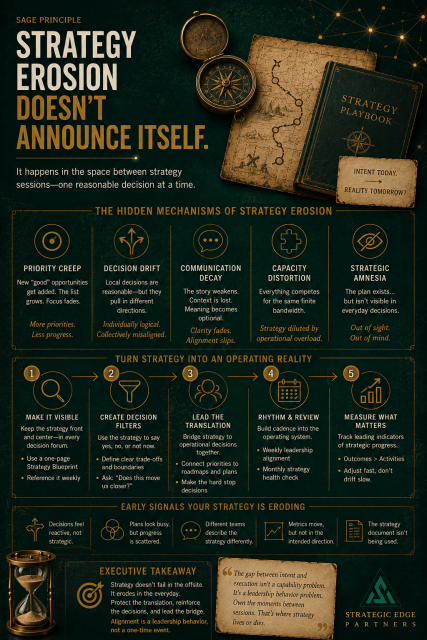
The first is priority creep. The leadership team leaves the strategy session with a clear set of priorities. Two weeks later, an attractive opportunity arrives that wasn’t in the plan. It gets resourced because it looks like a win, and the strategic case for it can be constructed convincingly enough in the moment. Then another. Then another. Within a quarter, the organization is pursuing eight priorities instead of four, each one individually justifiable and collectively incoherent. The strategy didn’t get abandoned. It got diluted one reasonable decision at a time.
The second is decision drift. When individual leaders make operational decisions without testing them against the strategy, the cumulative effect pulls the organization in a direction the leadership team never agreed to. A hiring decision is made based on immediate capacity needs rather than strategic capability requirements. A product investment gets approved because the customer asking for it is large enough to make the conversation difficult to decline. A partnership gets signed because the commercial terms are attractive without a clear examination of whether it fits the strategic direction. Each decision looks defensible in isolation. Together, they represent a strategy that has been quietly renegotiated through a series of operational calls.
The third is communication decay. In the weeks immediately following a strategy session, most leaders are still close enough to the content that they reference it naturally in their conversations with their teams. As time passes and operational demands accumulate, the references become less frequent. The language the leadership team used to describe the strategy starts to drift as each leader paraphrases it slightly differently. The middle layer of the organization, the people making daily decisions about priorities, product direction, customer investment, and resource allocation, starts to receive a weaker and more varied signal about what the strategy actually requires. The strategy doesn’t disappear from the organization. It just becomes progressively less legible at the levels where it needs to be clearest.
What distinguishes leadership teams that sustain strategy from those that don’t isn’t the quality of the planning work. It’s three behavioural disciplines that operate between sessions rather than inside them.
The first is decision referencing. Every significant operational decision is explicitly tested against the strategy before it is made. Not as a compliance exercise, but as a genuine question: does this decision move us toward the outcome we agreed to, or does it divert resources and attention elsewhere? This discipline sounds simple and is genuinely difficult to maintain under operational pressure. The deals that don’t quite fit the target segment still look attractive. The product investments outside the strategic focus still have legitimate customer demand. The discipline of referencing the strategy before saying yes is what keeps individual decisions from accumulating into strategic drift.
The second is consistent language. The leadership team uses the same words to describe the strategy at every level of the organization and in every context. Not a communications exercise. A strategic discipline. When the Chief Executive Officer describes the North Star differently in a board meeting than the Chief Product Officer describes it in a product review, the organization receives two different signals and resolves the ambiguity on its own terms. Consistent language at the leadership level is what keeps the strategy legible as it moves through the organization. It requires the leadership team to have genuine shared clarity about how the strategy is described, not just what was written in the document.
The third is visible prioritization. Leadership teams that sustain strategy make their prioritization decisions visible and connect them explicitly to the strategic direction. When something comes off the roadmap, the reason gets named, and it connects to the strategy. When a deal gets declined, the reasoning gets shared, and it references the focus the strategy requires. When a resource allocation decision gets made, it gets framed in terms of what the strategy needs rather than just what the operational situation demands. This visibility does two things. It reinforces the strategy as a real operating filter rather than a planning document. And it gives the middle layer of the organization a consistent signal about how strategic decisions are actually made, which, over time, builds the capability to make those decisions independently.
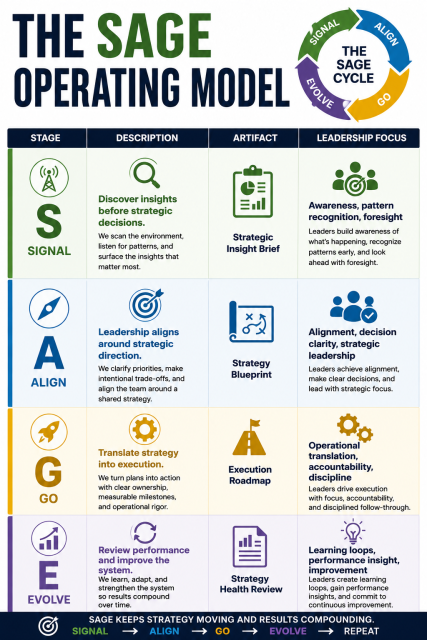
In the SAGE operating model, the Embed stage is where this capability is built into the organization rather than residing in the leadership team’s memory from the strategy session. The Strategy Blueprint becomes a working document rather than a planning artifact. The leadership team develops the discipline of referencing it in operational conversations. The review cadence keeps the strategy current. The language becomes consistent enough that it starts to travel through the organization without needing to be carried by the leadership team in every conversation.
This is the point in a strategic engagement when the organization no longer needs external facilitation to sustain its strategic discipline and begins running it internally. Not because the work is finished, but because the capability has been transferred. The leadership team knows how to examine the strategy, test decisions against it, keep the language consistent, and recognize when the strategy needs to be revisited rather than just reinforced.
For SaaS executives, the question this article really asks is whether the leadership team has a strategy or a strategy document. The difference shows up entirely in what happens between planning sessions. A strategy that exists only in a document is revisited annually and ignored operationally. A leadership behaviour strategy is reinforced daily by the decisions, language, and prioritization choices of the people responsible for sustaining it.
The planning work creates the strategy. Leadership behaviour between sessions determines whether it survives contact with reality.