
Strategy, Governance, and Delivery Leadership
Portfolio Delivery | Transformation Recovery | Governance Design
Two decades of measurable outcomes.
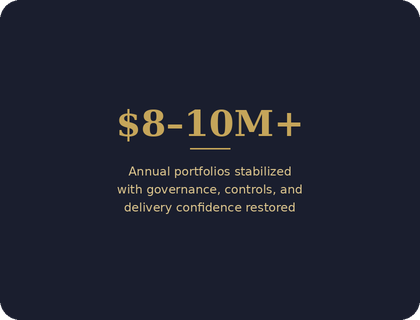
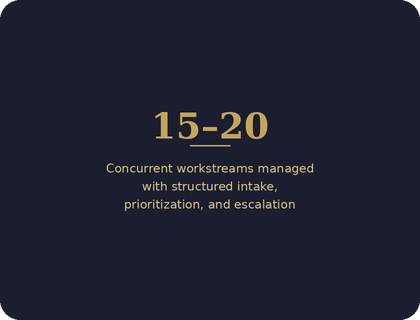
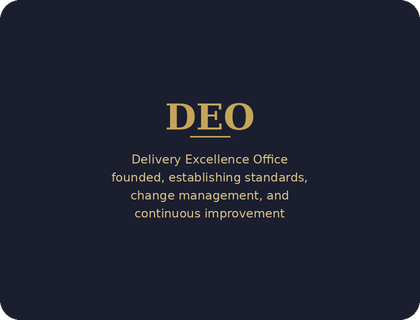
Organizations bring me in when transformation stops delivering.
Director and executive-level leader across healthcare and technology. I operate at the intersection of strategy, governance, and execution, typically engaged when portfolios have lost direction, delivery has slowed, and operating models no longer support what leadership needs to accomplish.

Most transformation challenges are not caused by strategy.
They are caused by an execution breakdown. I typically support leadership teams facing systemic issues that look different on the surface but share the same root causes.
Programs are reporting green while the delivery reality is red. Status reporting has become performance theatre, not decision support.
Portfolios lack prioritization, control, or clear value alignment. Everything is a priority, so nothing is.
Decision-making is slow, fragmented, or unclear. Leaders are accountable for outcomes but lack the authority or information to make timely calls.
Technology, product, and operations are misaligned. Teams are busy, but outcomes are not being realized.
Operating models no longer support scale, speed, or change. What worked at an earlier stage is now creating friction.
Improvement initiatives launch without a foundation. Teams implement methodologies on top of processes that have never been mapped, questioned, or validated.
Leaders are accountable for outcomes they do not have the authority to control. Responsibility flows down, but decision rights do not.
Critical processes live in people’s heads, not in systems. The organization runs on expertise it cannot see, transfer, or scale.

Strategy, governance, and execution move together.
Most organizations have all three happening independently. My job is to connect them.
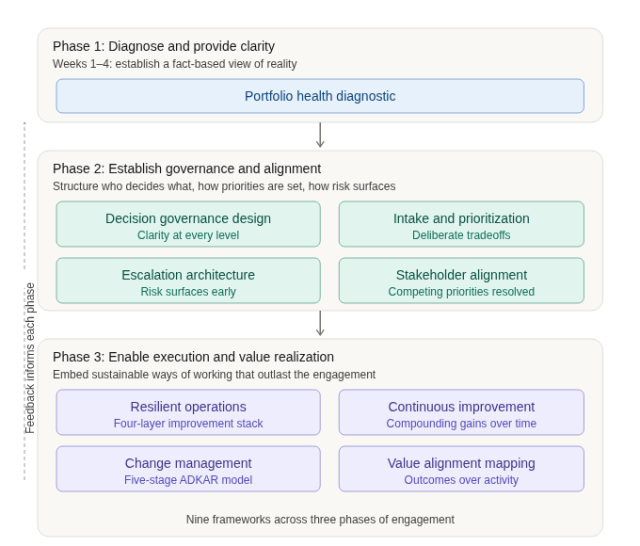
Phase 1
Diagnose and Provide Clarity
Rapid assessment of portfolio health, delivery risk, and governance maturity. A fact-based view of reality, not another audit deck. Typically, two to four weeks.
Phase 2
Establish Governance and Alignment
Redesign governance, decision frameworks, and accountability structures. Establish who decides what, how priorities are set, and how risk surfaces before it becomes a crisis.
Phase 3
Enable Execution and Value Realization
Accelerate delivery while maintaining control and quality. Link initiatives to measurable business outcomes. Embed sustainable ways of working that outlast the engagement.
Frameworks and Thinking Models
These frameworks were built inside real delivery environments, not designed in theory. Each one addresses a recurring structural problem I have seen across healthcare, technology, and complex multi-stakeholder organizations. They are the tools I bring into every engagement.
Resilient Operations Framework
Four-layer sequenced approach to sustainable operational improvement. Addresses the root cause of initiative failure: applying methodologies without building the foundation they require.
Stakeholder Alignment Framework
Practical approach to aligning competing priorities across organizational boundaries. Effective in shared services and multi-authority healthcare environments.
Change Management Framework
Five-stage model grounded in ADKAR and Lean principles. Covers awareness, alignment, adoption, reinforcement, and integration.
Continuous Improvement Cycle
Structured lifecycle for tracking improvement initiatives from capture through standardization and measurement, with documented learning at each stage.
Decision Governance Design
Structured frameworks for who decides what, how priorities are set, and how risk surfaces. Replaces ambiguity with clarity at every level.
Portfolio Health Diagnostic
Rapid assessment of delivery risk, governance maturity, and alignment gaps. Establishes a fact-based view of reality within the first two to four weeks.

If your organization is navigating these challenges, let’s talk.
The earlier these issues are addressed, the faster organizations move from activity to value. Most of the leaders I work with knew something was wrong long before they made the call. The programs were busy but not progressing. The reporting looked fine, but felt wrong. The team was talented, but the outcomes did not match the effort. If any of that sounds familiar, a confidential conversation costs nothing and often clarifies everything.