When was the last time every leader in your organization could explain in one sentence what the company is trying to become, and have all those sentences mean the same thing?
Most SaaS leadership teams can’t pass that test. Not because they lack strategic ambition, but because what gets called a North Star inside most organizations is actually a revenue target with better branding. Grow to fifty million ARR. Reach a hundred thousand customers. Achieve category leadership by the end of next year. These are outcomes worth pursuing. They are not a strategic direction. They tell the organization how much without telling it what, who, or why. And in the gap between how much and everything else, execution fractures.
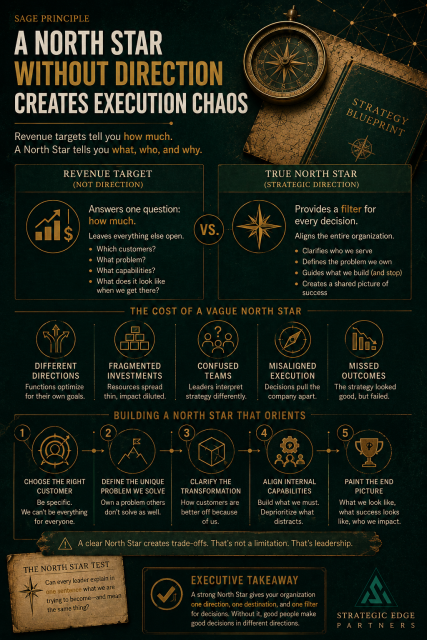
This distinction matters more than it might seem. A revenue target answers one question and leaves every other question open. Which customers are we building for? What problem are we uniquely positioned to solve? Which capabilities need to exist that don’t exist today? What does the organization look like when we get there? In the absence of answers to those questions, every function develops its own. The product team builds toward the customers they find most interesting. The sales team pursues the deals they can close fastest. The customer success team designs for the accounts currently generating the most support volume. Nobody is making a bad call. Everyone is filling a vacuum that the North Star was supposed to eliminate.
The result looks like execution chaos, but the source is strategic vagueness. By the time it surfaces as missed targets, misaligned product investments, or a sales motion that doesn’t quite fit the product being built, the leadership team is diagnosing an execution problem that was actually decided upstream, in the moment they mistook a financial goal for strategic clarity.
Here is what a genuine North Star does that a revenue target cannot. It orients decisions. Not the big visible strategic decisions that make it onto the leadership agenda, but the hundreds of smaller decisions made every week by product managers, sales leaders, customer success teams, and engineering leads who are trying to figure out what to prioritize when the answer isn’t obvious. A revenue target gives them a number to work toward. A genuine North Star gives them a filter.
The difference in practice is significant. A SaaS company whose North Star is becoming the operating system for mid-market professional services firms has a filter. The product manager deciding whether to build a general-purpose integration or a deep integration with the three tools that mid-market professional services firms use to run their businesses has an answer. The sales leader deciding whether to pursue a large enterprise deal outside the target segment has a framework for the trade-off. The Chief Executive Officer deciding where to invest the next engineering quarter has a reference point that isn’t just the revenue forecast.
A company whose North Star is reaching fifty million ARR has none of that. Every one of those decisions gets made on local logic, individual judgment, and whatever the most senior person in the room thinks the business needs. Some of those calls will be right. Collectively, they will produce an organization that has grown in several directions at once and isn’t particularly strong in any of them.
The clarity problem inside SaaS leadership teams tends to have a specific shape. The North Star gets set at the level of abstraction where everyone can agree. Become the leader in our category. Build a product customers love. Create a company that changes how teams work. These statements are not wrong. They are not useful either. They survive the leadership session because nobody can object to them, and they fail in execution for exactly the same reason. A statement that everyone agrees with usually means a statement that nobody has to change anything to accommodate.
What happens in the room is worth examining closely. Leadership sessions that produce vague North Stars tend to follow a recognizable pattern. A direction gets proposed. Someone raises a concern about a customer segment that gets left out. Someone else flags a market opportunity that the proposed direction doesn’t account for. The statement gets softened to incorporate both concerns. Then it gets softened again when the head of product points out that the current roadmap doesn’t quite fit the original framing. By the end of the session, the North Star has been edited into something everyone can live with, which is precisely the problem. Strategic clarity isn’t produced by consensus. It’s produced by making choices with consequences and committing to them, even when some leaders in the room would have chosen differently.
The abstraction also creates a specific kind of organizational paralysis that’s easy to misdiagnose. When the North Star is vague, middle leadership fills the vacuum with their own interpretation. A director of product management builds their quarterly plan around the customers they talk to most. A regional sales leader prioritizes the verticals where their team has the most existing relationships. A customer success manager designs the onboarding experience for the accounts that generate the most support tickets. Each of those decisions is locally reasonable. Collectively, they produce an organization in which three different customer profiles are served with varying levels of intentionality, and none of them is particularly well served. When results disappoint, the post-mortem focuses on execution quality. The actual issue, that nobody was working from the same picture of who the product was for, never gets named.
A genuine North Star creates productive disagreement. It forces the leadership team to make choices that have consequences. Naming a specific customer segment means explicitly not optimizing for others. Defining a specific problem worth solving means declining to build features that fall outside it. Describing what the organization needs to become means naming capabilities it doesn’t currently have and committing to building them. These choices create friction in the leadership session. They are also the choices that make execution coherent.
The organizations that execute their strategies well tend to have gone through that friction rather than around it. The North Star they came out with is narrower than what they started with, more specific than felt comfortable, and clear enough that a product manager or a sales leader can use it to make a decision without escalating.
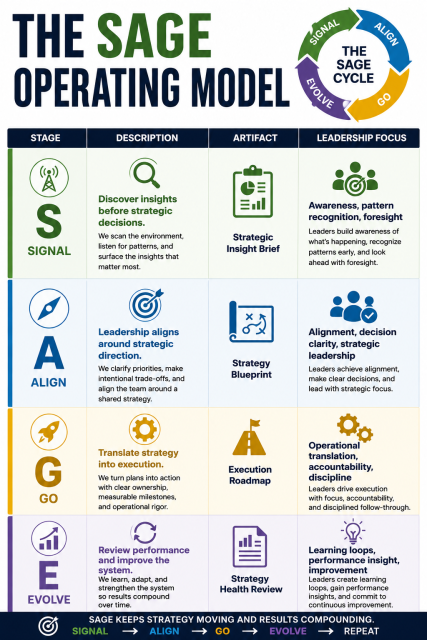
In the SAGE operating model, the Strategy Blueprint captures the North Star outcome as the first and most foundational element. Not the revenue target. The outcome the organization is building toward is specific enough to orient decisions. What does the customer look like? What problem is solved? What does the market position look like when the strategy is working? What does the organization need to be capable of that it isn’t today?
The Blueprint also captures what the strategy is not, and this is the element most leadership teams leave out. The boundaries of the North Star matter as much as the North Star itself. Without them, the strategy expands to accommodate whatever comes through the door. A clearly defined North Star with clearly defined boundaries gives the leadership team something to test decisions against. It makes the strategy operational rather than aspirational.
The test worth running before the next planning cycle is simple. Ask every member of the leadership team to write down in one sentence what the organization is trying to become in the next two to three years. Not the revenue target. Not the mission statement. The specific outcome the strategy is designed to produce. Collect the answers before anyone sees anyone else’s.
The variation in those answers is a direct measure of how much strategic clarity the leadership team actually has. If the sentences are substantively different, which they usually are, the issue isn’t that the team hasn’t communicated the strategy. It’s that the strategy hasn’t been defined clearly enough to produce the same sentence in every leader’s head.
What to do with that variation matters as much as finding it. The instinct in most leadership teams is to reconcile the sentences into a single statement everyone can endorse. That produces the same problem in a different form. The goal isn’t a sentence everyone agrees with. It’s a sentence that reflects a genuine shared understanding of the choices the strategy has already made.
That conversation is harder than it sounds. It requires the leadership team to examine where the variation came from, which usually means examining where the strategy itself is underdefined. Where the customer hasn’t been named specifically enough. Where the problem being solved has been described at a level of generality that allows multiple interpretations. Where the boundaries of the strategy haven’t been stated, each leader has drawn their own.
A useful North Star statement is specific enough to exclude something. If it doesn’t exclude anything, it isn’t doing the work. Testing a candidate statement against a real decision the organization faces is the fastest way to find out whether it has edges. If the statement doesn’t help resolve the decision, it’s still too vague. If it does help resolve it, and the resolution creates some discomfort because it means leaving something on the table, the statement is probably close to right.
Running this test before the planning cycle starts, rather than after, gives the leadership team something valuable: a clear view of where the strategic picture needs sharpening before execution begins. That’s a much cheaper problem to solve at the planning stage than six months into a quarter when the divergence has already shown up in the results.
Revenue targets tell the organization how much. A North Star tells it where. Those are different questions, and only one of them makes execution coherent.