What would your competitors have to do before your leadership team noticed?
That’s not a rhetorical question. It’s a useful one to sit with, because most executive teams have a faster answer for what’s happening inside the organization than for what’s forming outside it.
The environment is generating information constantly. Markets shift. Customer priorities change before the metrics catch up. Competitors move in directions that don’t show up in a quarterly brief. Regulatory conditions evolve. Technology changes what’s possible for adjacent industries before it changes yours. None of this is hidden. Most of it is observable. The question is whether the leadership team is asking the right questions to surface what matters before a decision point arrives.
This is what signal detection actually means. Not data collection. Not a research function. A deliberate practice of environmental inquiry that happens before strategy decisions are made.
Most leadership teams skip this, not out of negligence, but because the strategy process begins at alignment. By the time a leadership team sits down to set direction, someone has already framed the situation. The competitive landscape has been summarized. The market has been characterized. The assumptions embedded in that framing go largely unexamined, because the work of the session is to decide, not to question the picture.
What gets lost in that sequence is the signal layer. The observations that don’t fit the current framing. The customer behaviour that’s shifted in a direction nobody has built a metric for yet. The competitor is making a quiet move that looks minor until it doesn’t. The industry dynamic is changing at the edges of the market, where it’s easy to dismiss as irrelevant until relevance is obvious and the window for response has narrowed considerably.
Strong strategists read the environment as a discipline. They come to strategy conversations having actively questioned their own assumptions about what’s changing. They distinguish between signals worth examining and noise worth ignoring, and they make that distinction deliberately rather than by default.
That distinction is harder than it looks. Signals that matter rarely arrive labelled as such. They’re often ambiguous, early, or inconvenient relative to the current plan. The natural tendency is to weigh information that confirms existing direction and treat complicating observations as exceptions. This is not a character flaw. It’s what happens when inquiry is not structured to resist it.
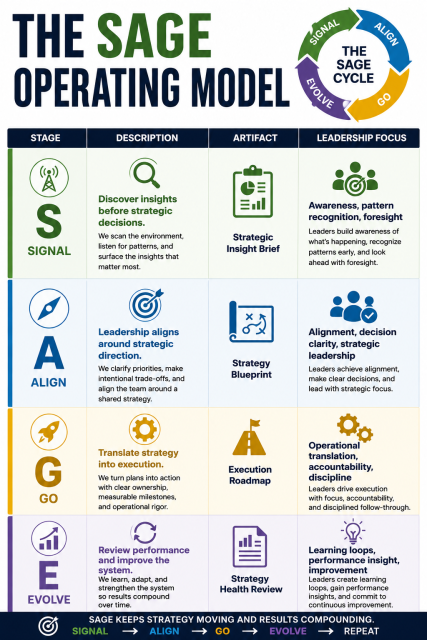
In the SAGE operating model, Signal is the first stage for this reason. Before a leadership team aligns around a strategic direction, it needs a clear-eyed read of what the environment is actually saying. That means asking questions that the current strategy wasn’t built to answer. What’s changing in how customers are thinking about this problem? Where is competition forming that we haven’t been watching closely? What assumptions in our current plan have started to look different in the last six months? What are we seeing at the edges of our market that we’ve been treating as noise?
The artifact produced at this stage is the Strategic Insight Brief.
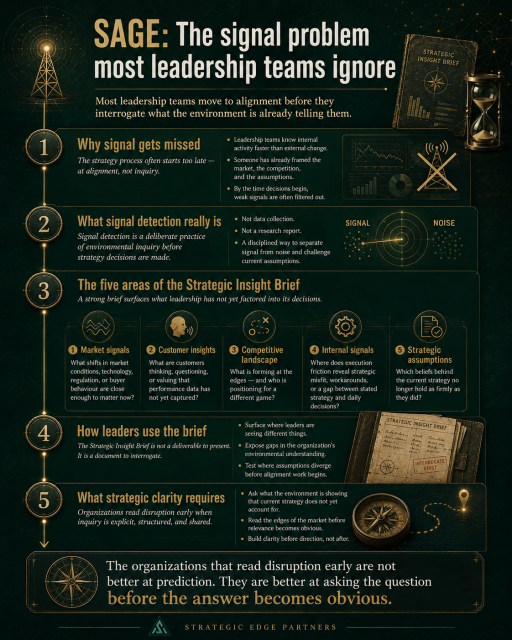
A well-constructed brief is not a market overview or a summary of what the team already knows. It’s a specific, honest account of what the environment is telling a leadership team that it hasn’t yet factored into its decisions. It covers five areas, and the discipline is in how honestly each one is examined.
The first is market signals. What’s changing in the broader environment that has potential strategic relevance? This isn’t a macro trend summary. It’s a focused question about which shifts in market conditions, buyer behaviour, technology, or regulation are close enough to your strategic position to matter in the next planning cycle. The point is not to be comprehensive. It’s to be specific about what’s actually moving.
The second is customer insights. Not satisfaction scores. Not NPS. The question here is what customers are thinking about, what problems they’re trying to solve, and whether any of that has shifted in ways that aren’t yet visible in the performance data. Customers signal strategic change before it shows up in revenue. Their questions change, their evaluation criteria shift, and the alternatives they’re considering evolve. A brief that captures this honestly often surfaces the most uncomfortable and most valuable information in the document.
The third is the competitive landscape. Where are competitors investing? What moves have they made in the last six to twelve months that didn’t get much attention at the time? The relevant question isn’t who’s winning the current game. It’s who’s positioning for a different game, and whether that positioning matters. Competitive analysis inside most strategy processes focuses on what’s already happened. The signal layer asks what’s forming.
The fourth is internal signals. This is the one that’s easy to overlook because it feels like operational territory. It isn’t. There are things happening inside an organization that reflect strategic reality before leadership has named it. Where is execution consistently harder than it should be? Where are teams working around processes or structures that no longer fit the actual work? Where is the gap between stated strategy and daily decision-making widest? These aren’t process problems to fix. They’re signals about whether the current strategy is as clear and coherent as the leadership team believes.
The fifth is strategic assumptions. Every current strategy rests on a set of beliefs about how the market works, what customers value, where competition will come from, and what capabilities matter. The brief makes those assumptions explicit and asks which ones have started to look different given everything else in the document. This is often the hardest section to write honestly, because it requires the leadership team to name what it believed when it set the current direction, and then examine whether those beliefs still hold.
Together, these five areas create something a market summary can’t: a structured basis for asking better questions before strategy work begins. The brief isn’t a deliverable to present. It’s a document to interrogate.
When a leadership team reviews a Strategic Insight Brief together, the goal isn’t to agree on the findings. It’s to surface where team members are seeing different things, where assumptions diverge, and where the organization’s understanding of the environment has gaps. Those conversations, before the alignment work starts, are where strategic clarity actually gets built.
For executives and founders, the practical question is whether this kind of inquiry is explicit in how you prepare for strategy decisions. Not a research report that arrives before the meeting. An active practice of asking, as a leadership team, what the environment is showing you that your current strategy doesn’t yet account for.
The organizations that read disruption early are not better at prediction. They’re better at asking the question before the answer becomes obvious.